
Agentic AI: The Next Step in Intelligent Automation
Artificial Intelligence is evolving beyond systems that simply answer questions or generate content. A newer approach, known as Agentic AI, focuses on helping AI systems work toward goals by planning tasks, taking actions, using tools, and evaluating results.
This shift could change how businesses approach automation and everyday workflows.
What Is Agentic AI?
Agentic AI refers to AI systems designed to work toward a specific objective with a certain level of autonomy.
Traditional AI generally follows this pattern:
Prompt → AI → Response
Agentic AI can follow a more dynamic process:
Goal → Plan → Act → Evaluate → Adapt
For example, instead of asking AI to simply summarize customer feedback, a business could give an AI agent the goal of analyzing customer feedback, identifying common problems, and preparing recommendations.
The agent can break the objective into smaller steps and work through them.
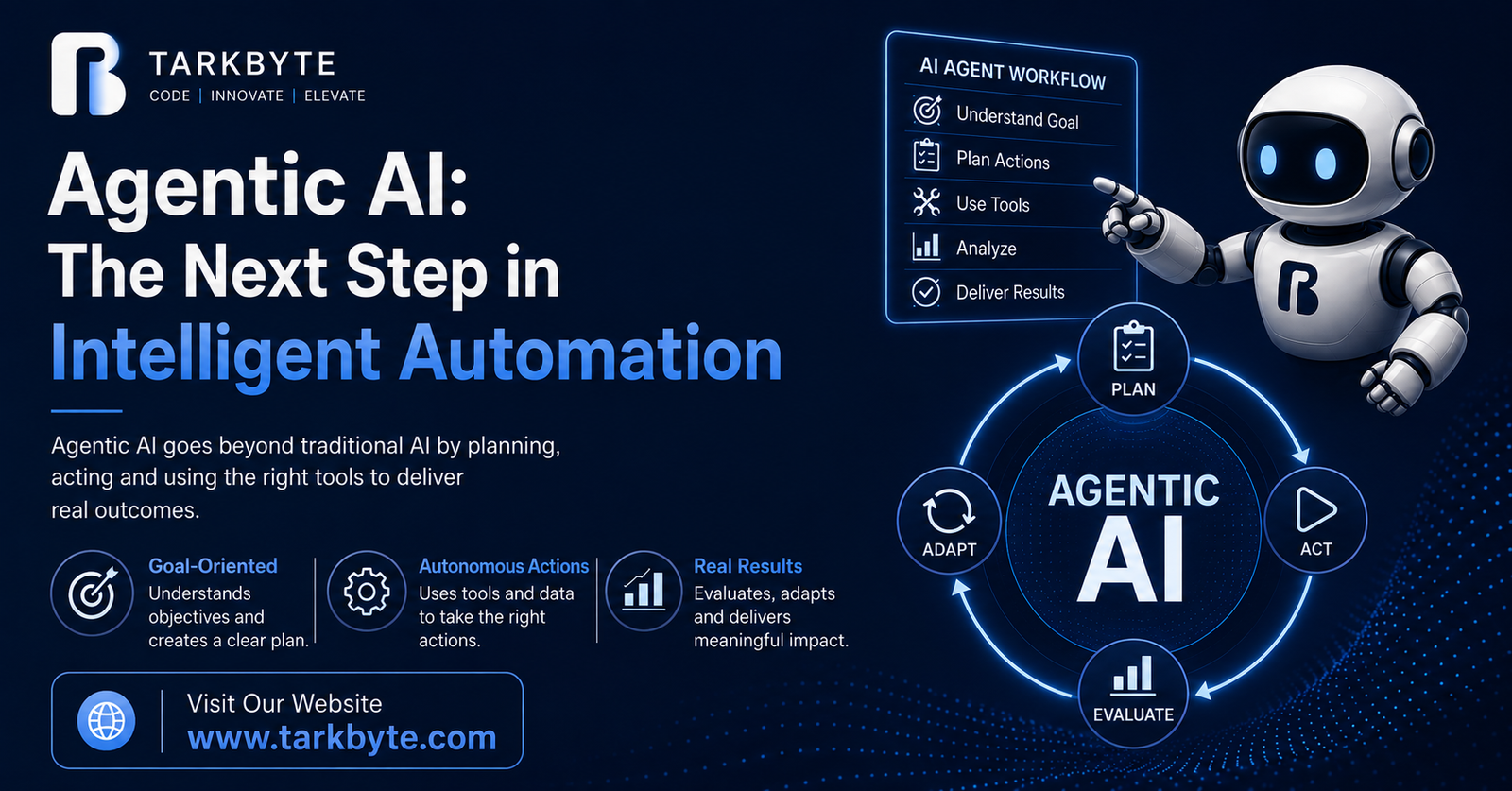
How Does Agentic AI Work?
An AI agent can combine several capabilities to complete a task:
1. Understand the Goal
The system interprets what the user or business wants to accomplish.
2. Create a Plan
It determines which actions may be required to reach the desired outcome.
3. Use Tools
Depending on its permissions, an agent may interact with databases, APIs, software platforms, documents, or other digital tools.
4. Evaluate Results
The system can review the information it receives and determine whether additional steps are needed.
5. Adapt
If an approach does not produce the expected result, the agent may adjust its plan and try another approach.
This ability to work through multiple connected steps is what makes Agentic AI different from a basic chatbot.
Where Can Businesses Use Agentic AI?
Agentic AI has potential applications across many industries.
Customer Support: Agents can help understand customer requests, retrieve information, and route complicated issues to human teams.
Sales: AI can assist with lead research, organizing customer information, and preparing follow-up workflows.
Software Development: Agents can support developers with code analysis, testing, documentation, and troubleshooting.
Business Research: AI agents can gather and organize information, identify patterns, and prepare structured reports.
Operations: Agents can assist with repetitive workflows, monitoring, reporting, and coordination between different systems.
What Are the Benefits?
The biggest advantage of Agentic AI is that it can move AI from simply providing answers to helping complete tasks.
Potential benefits include:
Reduced repetitive work
Faster business processes
Better use of large amounts of data
Increased employee productivity
More scalable automation
Improved decision support
Instead of employees manually handling every step of a process, AI agents can potentially manage routine parts while people focus on higher-value decisions.
What Are the Challenges?
Greater autonomy also brings greater responsibility.
An AI system that can take actions independently may create problems if it has incorrect information, excessive permissions, or insufficient safeguards.
Businesses should consider:
Data privacy
Security
Access permissions
Human approval for sensitive actions
Monitoring and testing
Clear limits on what an AI agent can do
Human oversight remains important, especially when AI is connected to important business systems.
Will Agentic AI Replace People?
Agentic AI is more likely to change how people work than simply replace everyone.
AI can handle repetitive tasks and process large amounts of information, while people remain essential for creativity, leadership, communication, strategic thinking, and important decisions.
The future may involve employees working alongside AI agents—delegating routine tasks, reviewing results, and focusing their time where human judgment matters most.
The Future of Agentic AI
As AI systems become better at reasoning, using tools, and working with different software platforms, Agentic AI could become an important part of business operations.
The goal should not be to automate everything.
Instead, businesses should identify where intelligent automation can create genuine value and introduce AI with appropriate security, control, and human oversight.
Final Thoughts
Agentic AI represents a shift from AI that primarily responds to AI that can work toward a goal.
Its ability to plan, act, evaluate, and adapt could open new possibilities for automation, software development, customer service, research, and business operations.
The businesses that benefit most may not be those using the most AI, but those that understand where AI can solve real problems and improve the way people work.