
AI Agents vs Chatbots: What’s the Difference and How Can Businesses Benefit?
AI Agents vs Chatbots: What’s the Difference and How Can Businesses Benefit?
Artificial intelligence is becoming a bigger part of everyday business operations.
But there is an important distinction that is often overlooked:
AI chatbots and AI agents are not the same thing.
Both can interact with users, understand natural language, and provide useful responses. The difference is in what they are designed to do.
A chatbot primarily responds to a conversation.
An AI agent can go a step further by working toward a goal, using available tools, and taking actions within the permissions it has been given.
Let’s break it down.
What Is an AI Chatbot?
A chatbot is a software system designed to communicate with users through conversation.
For example, a customer might ask:
“What are your business hours?”
The chatbot can provide the relevant information.
A customer could also ask:
“Where is my order?”
Depending on how the chatbot is built and what systems it can access, it may be able to retrieve the order information and provide an answer.
Chatbots are particularly useful for:
- Frequently asked questions
- Customer support
- Basic troubleshooting
- Product information
- Website assistance
- Collecting initial customer information
They’re excellent at handling conversations and repetitive questions.
What Is an AI Agent?
An AI agent is designed around a different idea.
Instead of simply responding to a question, an agent can be designed to work toward completing a particular objective.
For example, imagine a customer says:
“My order hasn’t arrived yet. Can you help?”
A more capable AI agent could potentially:
Understand the request → Check the order system → Identify the shipment status → Determine the next step → Take an appropriate action
The exact capabilities depend on the systems, tools, permissions, and safeguards provided to the agent.
This is what makes agents particularly interesting for business automation.
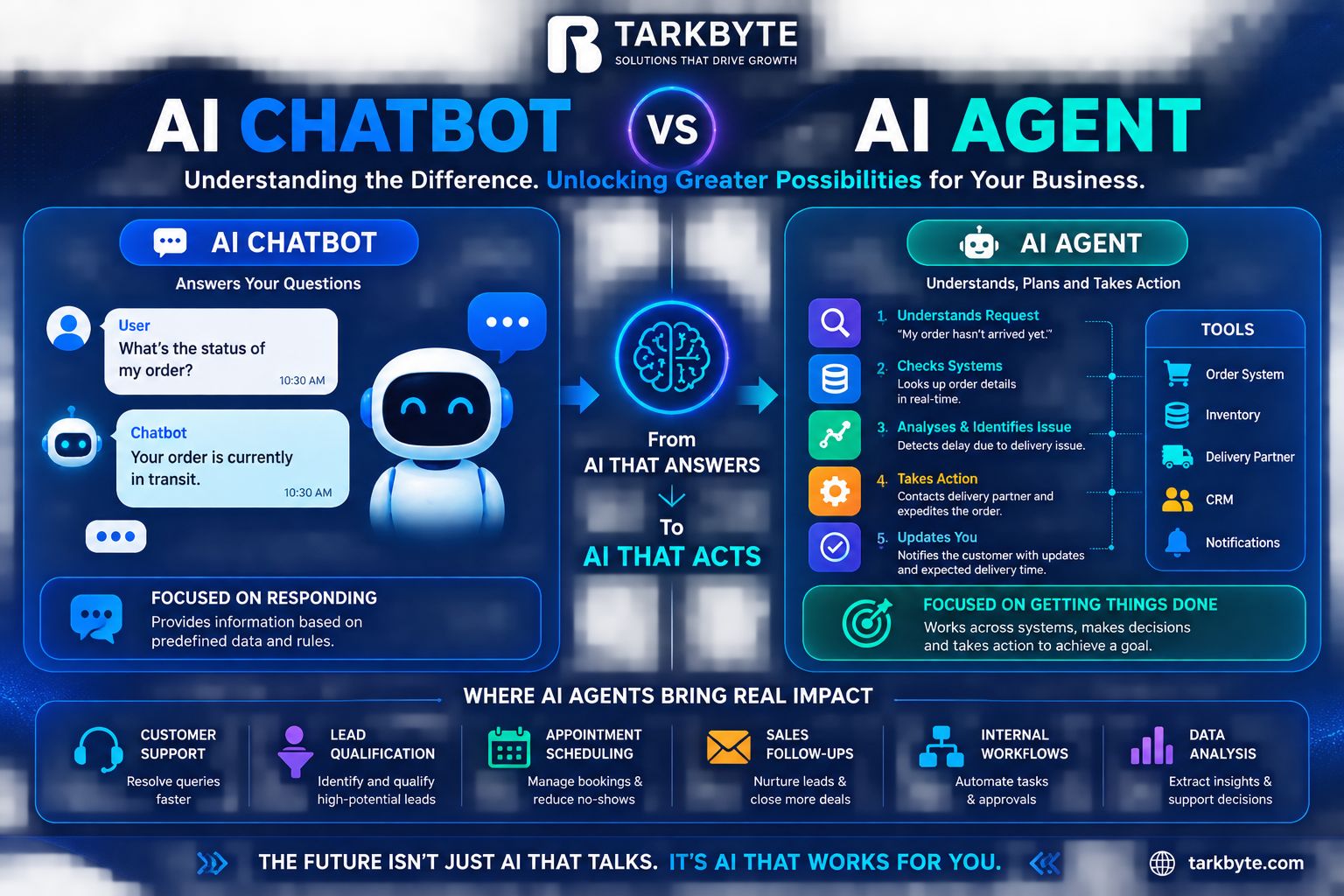
Chatbot vs AI Agent
A simple way to understand the difference is:
| AI Chatbot | AI Agent |
|---|---|
| Primarily responds | Works toward a goal |
| Conversation-focused | Task-focused |
| Answers questions | Can perform multi-step tasks |
| Usually follows predefined flows or responses | Can dynamically determine steps |
| Limited tool usage in simpler systems | Can be connected to multiple tools |
| Best for repetitive conversations | Useful for more complex workflows |
This doesn’t mean AI agents will replace every chatbot.
In fact, many businesses may benefit from using both.
How Can Businesses Use AI Agents?
1. Customer Support
An AI agent can potentially connect with a company’s knowledge base and business systems to help resolve customer requests.
Instead of simply answering:
“Our support team will contact you.”
The system could potentially gather information, check relevant records, and guide the customer through the appropriate process.
2. Lead Qualification
Imagine receiving dozens of enquiries every day.
An AI agent could ask potential customers relevant questions, understand their requirements, organize the information, and pass qualified leads to the sales team.
This can reduce repetitive manual work.
3. Appointment Scheduling
An AI agent can be connected to scheduling systems to help users find suitable appointment times and complete the booking process.
Instead of simply providing a booking link, the system can potentially handle more of the conversation itself.
4. Internal Business Workflows
AI agents aren’t limited to customer-facing applications.
They can also be used internally to assist with tasks such as:
- Finding information
- Summarizing reports
- Processing requests
- Organizing data
- Creating workflow updates
- Assisting employees with routine tasks
Why Are AI Agents Becoming Important?
Businesses have been automating repetitive tasks for years.
What’s changing is the ability to combine:
Natural language + AI reasoning + Business data + Software tools + Automation
This allows businesses to build systems that can interact with information and software in a more flexible way.
But there is an important consideration.
More autonomy also means more responsibility.
AI agents need appropriate permissions, monitoring, testing, security controls, and human oversight—especially when they can make changes or take actions that affect customers, finances, or business operations.
The goal shouldn’t be to give AI unlimited control.
The goal should be to give it the right capabilities, within the right boundaries.
The Bigger Shift
The evolution of business AI can be viewed as a progression:
Search → Chat → Assist → Act
We’re moving from systems that simply help us find information toward systems that can potentially help us complete tasks.
That’s why AI agents are generating so much interest.
The most valuable question isn’t:
“Can we use an AI agent?”
It’s:
“Which business process would actually become better if an AI agent handled part of it?”
That’s where the real business value begins.
Final Thought
AI chatbots made conversations with software easier.
AI agents are taking the next step by making software capable of working toward tasks.
The future isn’t necessarily about AI doing everything.
It’s about finding the right balance between:
Human judgment + AI capabilities + Business automation
And that balance could fundamentally change how businesses operate.