
Why Do Websites Sometimes Become Slow Over Time?
Your website was fast when it launched.
A few months later, it starts taking longer to load.
Nothing seems dramatically different. So what happened?
Website performance can change over time because websites are not completely static. New content, features, users, plugins, databases, and traffic can gradually affect how efficiently a website works.
Here are some of the common reasons.
1. Large or Unoptimized Images
Images are important for making a website visually appealing, but large image files can significantly increase the amount of data a browser needs to download.
Uploading a high-resolution image directly from a camera or phone without optimization can make pages heavier than necessary.
Better approach: Resize images appropriately, compress them, and use modern image formats when suitable.
2. Too Many Plugins and Third-Party Tools
Plugins can add useful functionality, but every additional plugin or external service can introduce more code and network requests.
Over time, a website may accumulate features that are no longer necessary.
Regularly reviewing installed plugins and removing unused ones can help keep a website cleaner.
3. Database Buildup
Dynamic websites often store information such as posts, revisions, comments, settings, orders, and other data in a database.
As the amount of unnecessary data grows, certain database operations can become less efficient.
Database maintenance and optimization can therefore become part of long-term website management.
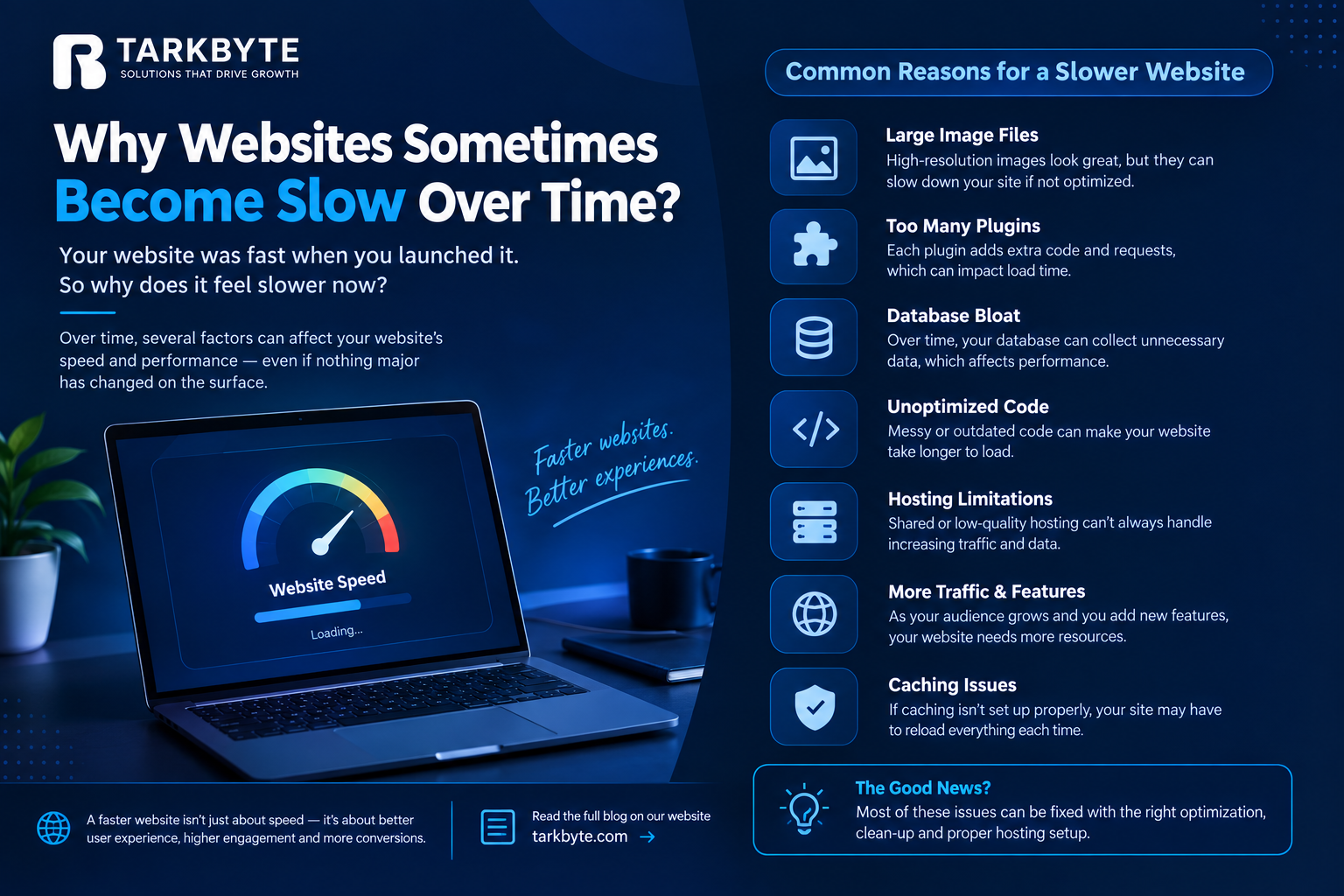
4. Website Code Can Become Heavier
Websites often evolve.
A simple website might eventually gain:
- More animations
- Additional JavaScript
- New integrations
- Tracking tools
- Extra features
- More complex pages
Each addition can affect performance if it isn’t implemented and optimized carefully.
The goal isn’t simply to have fewer features.
It’s to make sure the features being used are worth the performance cost.
5. Hosting May No Longer Match the Website
A website that works perfectly on a small hosting plan may behave differently as traffic, content, or functionality increases.
Hosting resources such as CPU, memory, storage, and server configuration can affect how quickly a website responds.
Sometimes the solution isn’t changing the website itself—it may be improving the hosting environment.
6. More Traffic Can Change Things
Imagine a website that normally receives 100 visitors a day.
Later, it starts receiving thousands.
That’s great news for the business—but the infrastructure needs to handle the additional demand.
More visitors can mean more requests to the server, databases, APIs, and other services.
A website needs to be designed and maintained with growth in mind.
7. Caching Isn’t Working Properly
Caching allows certain resources or generated results to be reused instead of being recreated or downloaded unnecessarily every time.
When caching is configured properly, it can reduce the amount of work required to serve a page.
If caching is missing, outdated, or incorrectly configured, visitors may experience slower loading.
So, Does a Slow Website Mean You Need a Completely New Website?
Not necessarily.
Sometimes the underlying website is perfectly usable and simply needs optimization.
A performance review can look at things such as:
Images → Code → Plugins → Database → Hosting → Caching → Network requests
The important thing is to identify the actual bottleneck instead of randomly changing things.
Website Speed Is More Than Just a Number
A faster website isn’t only about getting a better score on a testing tool.
It can contribute to a smoother user experience and make it easier for visitors to access the information they came for.
That’s why website performance should be treated as something to monitor and maintain, rather than something you check only once when a website launches.
Final Thought
A website isn’t a product you build once and forget.
As the website grows, its content, functionality, traffic, and technical environment change too.
Good website performance is an ongoing process.
And sometimes, the fastest website isn’t the one with the fewest features—it’s the one where every feature has been implemented thoughtfully.