
Jev vs RAG: What’s the Difference?
AI systems are becoming more than just chatbots. Behind many modern AI applications, different technologies handle different jobs.
Two terms getting attention are RAG and Jev.
But they solve different problems.
What is RAG?
RAG stands for Retrieval-Augmented Generation.
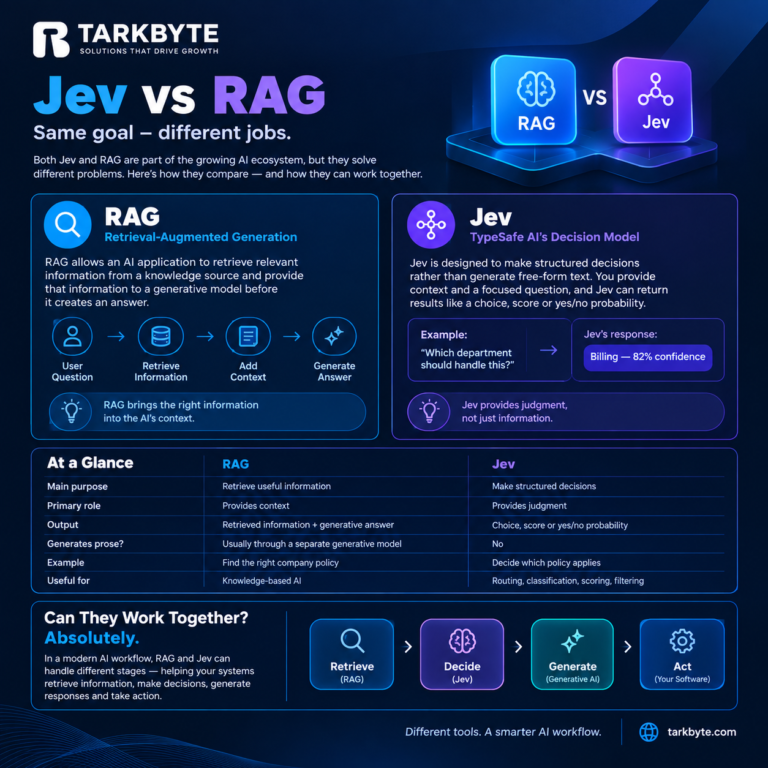
RAG allows an AI application to retrieve relevant information from a knowledge source—such as company documents, databases, or other indexed content—and provide that information to a generative AI model before it creates an answer.
A simple RAG flow looks like:
User Question → Retrieve Relevant Information → Add Context → Generate Answer
For example, a company could build a support assistant that retrieves information from its internal documentation before answering a customer’s question.
RAG is therefore mainly about bringing the right information into the AI’s context.
What is Jev?
Jev is TypeSafe AI’s first System One model, introduced in September 2026.
Unlike a traditional generative language model, Jev is designed to make structured decisions rather than generate free-form text.
You provide context and a focused question, and Jev can return structured results such as a choice, score, or yes/no probability.
For example:
Customer message → “Which department should handle this?”
Jev could return:
Billing — 82% confidence
Your software can then use that result to decide what happens next.
RAG vs Jev
| RAG | Jev | |
|---|---|---|
| Main purpose | Retrieve useful information | Make structured decisions |
| Primary role | Provides context | Provides judgment |
| Output | Retrieved information + generative answer | Choice, score or yes/no probability |
| Generates prose? | Usually through a separate generative model | No |
| Example | Find the right company policy | Decide which policy applies |
| Useful for | Knowledge-based AI | Routing, classification, scoring, filtering |
Can They Work Together?
Absolutely.
In fact, this is where the comparison becomes more interesting.
Imagine a customer asks:
“Can I get a refund for this order?”
A possible workflow could be:
1. RAG
Find the relevant refund policy.
2. Jev
Evaluate whether the retrieved policy actually applies to the customer’s situation.
3. Generative AI
Use the relevant information to create a clear response.
4. Your software
Decide whether to answer automatically, request more information, or send the case to a human.
This means RAG and Jev can occupy different stages of the same AI workflow. Recent examples specifically describe Jev being used to filter, rerank, or evaluate retrieved passages before generation.
So, Which One Should a Business Use?
That depends on the problem.
If the main challenge is:
“How can our AI access our company’s information?”
RAG may be part of the solution.
If the challenge is:
“How can our software make a consistent decision from available information?”
A decision model such as Jev may be relevant.
And for some applications, both can work together.
The Bigger Idea
Modern AI systems don’t necessarily need one model to do everything.
A useful architecture can divide responsibilities:
Retrieve → Decide → Generate → Act
RAG can help with the retrieve stage.
Jev can potentially help with the decide stage.
A generative model can handle generation, while ordinary software controls the final action.
That’s an important shift in how AI applications are being designed: different tools can handle different parts of the workflow.