
n8n vs LangGraph: Which Is Better for Building AI Agents?
AI agents are becoming an important part of modern business automation. From customer support and lead generation to research and internal workflows, businesses are increasingly looking for ways to build systems that can reason, use tools and complete tasks with less manual intervention.
Two technologies that often come up when building these workflows are n8n and LangGraph.
While both can be used to create AI-powered workflows, they approach the problem very differently.
What Is n8n?
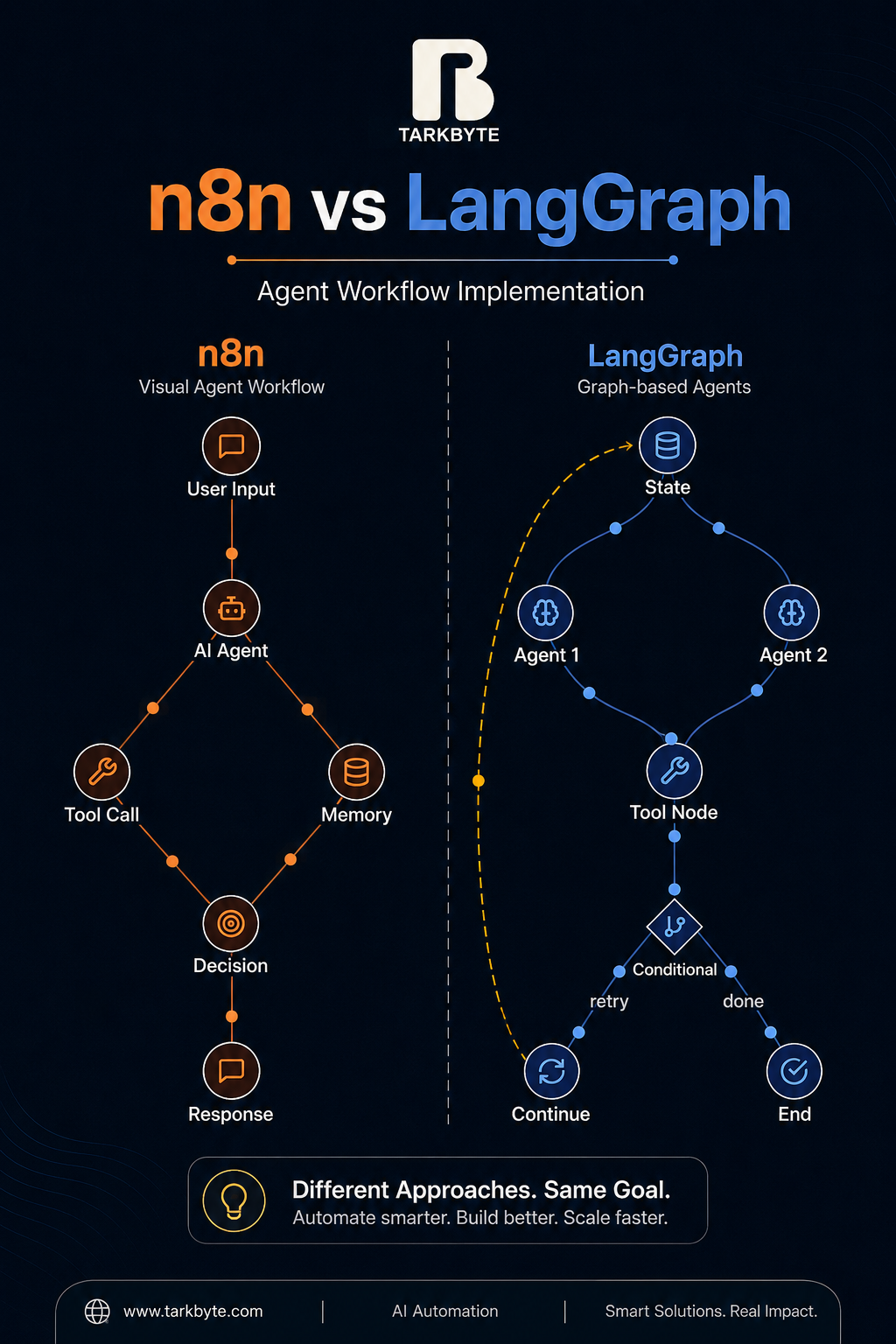
n8n is a workflow automation platform that allows you to connect applications, APIs, databases and AI services through visual workflows.
Instead of writing every component from scratch, you can create a workflow by connecting different nodes.
For example:
User Input → AI Agent → Tool → Memory → Decision → Response
This makes n8n particularly useful when you want to quickly connect AI with existing business systems.
What Is LangGraph?
LangGraph is designed for building more structured and controllable AI agent workflows.
Instead of thinking primarily in terms of a linear automation workflow, LangGraph represents an application as a graph of nodes and transitions, with state being carried through the workflow.
A simplified workflow could look like:
State → Agent 1 / Agent 2 → Tool → Conditional → Continue or End
This approach becomes especially useful when an AI system needs multiple agents, conditional routing, loops, retries or persistent state.
n8n vs LangGraph: Key Difference
The biggest difference is the way you build and control your workflows.
| Feature | n8n | LangGraph |
|---|---|---|
| Approach | Visual workflow automation | Graph-based agent orchestration |
| Coding | Low-code / visual | Code-oriented |
| Integrations | Very strong | Usually handled through code/integrations |
| Complex agent logic | Good | Excellent |
| State management | Available through workflow mechanisms | Core concept |
| Multi-agent systems | Possible | Strong fit |
| Speed of prototyping | Very fast | Requires more development |
| Developer control | Moderate | High |
| Business automation | Excellent | Good |
| Complex AI applications | Good | Excellent |
When Should You Use n8n?
n8n can be a strong choice when your primary goal is automation and integration.
For example, imagine a lead-generation system:
Website Form → AI Qualification → CRM → Email → WhatsApp Notification
A visual workflow makes this relatively easy to understand, modify and maintain.
n8n is particularly useful for:
- Connecting different business applications
- Automating repetitive tasks
- AI-powered workflows
- Lead management
- Email automation
- CRM integrations
- Data processing
- API integrations
- Rapid prototypes
For businesses that want to automate existing processes without building an entire AI application from scratch, n8n can be a practical option.
When Should You Use LangGraph?
LangGraph becomes more attractive when the AI system itself is the main application rather than simply one step inside an automation.
For example, a sophisticated research agent might need to:
- Understand a user’s request
- Plan the task
- Ask different agents to perform specialized work
- Call external tools
- Evaluate the results
- Retry failed operations
- Update its state
- Decide whether the task is complete
This type of workflow requires more control over state, transitions and decision-making.
LangGraph is therefore well suited for:
- Complex AI agents
- Multi-agent applications
- Stateful workflows
- Conditional execution
- Agent loops
- Retry mechanisms
- Tool-using agents
- Advanced AI applications
n8n vs LangGraph: Which One Is Better?
There isn’t a universal winner.
The better choice depends on what you’re trying to build.
Choose n8n if:
Speed + integrations + visual automation are your priorities.
If your workflow looks like:
Trigger → Process → AI → Database → Notification
n8n can be an excellent choice.
Choose LangGraph if:
Control + state + complex agent behavior are your priorities.
If your application looks more like:
Plan → Agent → Tool → Evaluate → Retry → Agent → Decide → Complete
LangGraph may be a better fit.
Can You Use n8n and LangGraph Together?
Yes.
They don’t necessarily have to compete with each other.
A powerful architecture can use both.
For example:
n8n can handle:
- Webhooks
- CRM integration
- Notifications
- Scheduling
- External APIs
while LangGraph can handle:
- Agent reasoning
- State management
- Multi-agent coordination
- Complex decision-making
- Tool selection
This creates a hybrid architecture where each technology handles what it does best.
Final Thoughts
n8n and LangGraph solve related but different problems.
n8n is excellent for connecting systems and creating visual automation workflows, while LangGraph is designed for building sophisticated, stateful AI agent applications.
The decision shouldn’t simply be about which technology is more powerful.
Instead, ask:
“How complex does my AI workflow need to become?”
For straightforward automation, n8n may be the faster and more practical choice.
For complex, stateful and multi-agent applications, LangGraph can provide the control needed to build a more sophisticated system.
And in many real-world projects, using both together may be the best solution.